










Why Choose a Catering Trolley for Your Business?
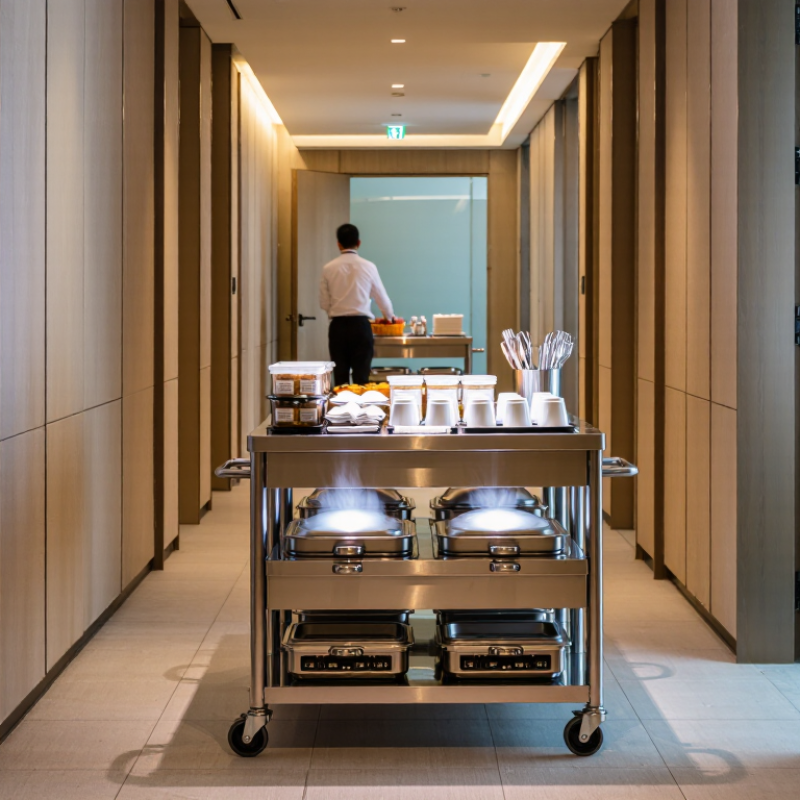
A Catering Trolley can change how food and beverages move through a busy business. It brings service closer to customers, reduces repeated trips, and creates a more organized presentation. In a hotel corridor, staff can roll hot dishes from the kitchen to a meeting room. In an office, a compact trolley can support coffee breaks without blocking shared work areas.
Small details matter. Locking wheels keep the trolley steady beside a table. Insulated compartments help maintain suitable temperatures during short service periods. Stainless steel surfaces allow practical cleaning after every use. Shelves can hold cups, plates, utensils, napkins, and labeled containers. This reduces searching during busy moments. Staff notice the difference.
However, a Catering Trolley is not automatically the best choice. Its size must match doorways, lifts, storage spaces, and service routes. A heavy model may slow employees on long corridors. A poorly designed trolley may create noise, clutter, or cleaning problems. These issues deserve honest attention before purchase. The right decision should reflect menu type, service frequency, staffing levels, and local food-safety requirements.
Experienced operators usually test a trolley during real service, not only in a showroom. They check turning space, handle comfort, wheel movement, loading balance, and cleaning time. Customer feedback can reveal practical weaknesses that specifications miss. A reliable supplier should provide clear materials, capacity details, maintenance guidance, and warranty terms. Good equipment supports people. It does not replace careful training or consistent service standards.
What Is a Catering Trolley and How Does It Work?
A catering trolley is a mobile service station designed to prepare, transport, and present food near guests. It usually includes shelves, insulated compartments, work surfaces, and locking wheels. Some models support hot holding, while others keep chilled ingredients safe during service. The exact setup depends on the menu and venue.
In daily use, staff load prepared food into separate sections before service begins. The trolley then moves from the kitchen to a dining room, meeting space, or outdoor area. At the service point, employees can portion meals, arrange plates, or finish simple dishes. This reduces repeated trips to the kitchen and keeps food presentation more controlled. From practical experience, wheel quality matters greatly on uneven floors. A trolley that looks strong may still move poorly when fully loaded.
Tips: Check the trolley’s weight capacity before buying. Keep hot and cold foods separated. Clean handles, shelves, and contact surfaces after every service. Test turning space in real working conditions. Measure doorways first. Small oversights can create delays, and that is easy to underestimate. Also, staff training should cover safe movement, temperature monitoring, and correct loading. A clear workflow improves service, but it may need adjustment after busy events reveal weaknesses.
Why Choose a Catering Trolley for Your Business? - What Is a Catering Trolley and How Does It Work?
| Category | Key Dimension | Typical Specification or Operating Detail | How It Works | Business Value |
|---|---|---|---|---|
| Basic Definition | Equipment purpose | A mobile food-service unit used to transport, hold, organize, and sometimes heat or chill prepared food. | Food is placed in compatible trays or containers, while the trolley supports movement between the kitchen, service area, dining room, event space, or delivery point. | Combines storage and transport in one unit, helping reduce manual handling and service delays. |
| Capacity | Tray and container capacity | Common commercial configurations accommodate approximately 10–20 full-size food trays, depending on tray depth and shelf spacing. | Adjustable or fixed rails hold trays securely and keep portions separated during movement. | Supports batch production and allows staff to move multiple portions in one trip. |
| Food Compatibility | Common tray formats | Many catering trolleys are designed around standardized food pans, including full-size and half-size gastronorm-style containers. | Tray rails or shelves create consistent spacing and make loading, unloading, and cleaning more predictable. | Improves kitchen organization and makes the trolley suitable for buffets, banquets, institutions, and large events. |
| Temperature Control | Insulated holding | Insulated models slow temperature loss but do not actively heat or cool food. | Insulated walls reduce heat transfer between the food compartment and the surrounding environment. | Useful when food needs to be transported over short distances without adding an electrical heating system. |
| Temperature Control | Heated holding | Heated units commonly use electric heating elements and thermostatic controls; hot-food operations often target at least 60°C, subject to local food-safety rules. | Heating elements warm the cabinet air or a water reservoir, while a thermostat helps maintain the selected temperature. | Helps maintain serving quality and reduces the need to reheat food before service. |
| Temperature Control | Refrigerated holding | Refrigerated units use a compressor or other cooling system; chilled-food operations commonly target 5°C or below, subject to local requirements. | A cooling circuit removes heat from the cabinet and circulates chilled air around the food containers. | Supports cold buffets, desserts, salads, dairy products, and other temperature-sensitive foods. |
| Mobility | Wheels and movement | Commercial models typically use four swivel casters, with at least two casters fitted with brakes. | Swivel casters improve maneuverability, while wheel brakes stabilize the trolley during loading and service. | Reduces lifting and carrying, particularly in large kitchens, hotels, care facilities, and event venues. |
| Construction | Materials and hygiene | Stainless steel is widely used because it is durable, corrosion-resistant, and relatively easy to clean. | Smooth internal surfaces and removable components help staff wipe down food-contact and high-touch areas. | Supports repeat daily use and can simplify cleaning routines when the design has fewer dirt-trapping joints. |
| Workflow | Typical operating sequence | Prepare food → load trays → set or verify temperature → transport → serve → clean and sanitize. | The trolley creates a controlled path between production and service, keeping food organized during each stage. | Standardizes service procedures and helps staff coordinate large-volume meal delivery. |
| Efficiency | Trips and handling | One loaded trolley can replace several individual carrying trips, depending on its capacity and the route layout. | Multiple trays move together in a stable, enclosed or semi-enclosed compartment. | Can reduce staff walking time, improve service speed, and lower the risk of dropped trays or spills. |
| Space Planning | Typical footprint | A full-size commercial trolley often requires approximately 0.5–0.9 m² of floor space, including maneuvering clearance. | The trolley is positioned in a designated storage, preparation, or service area when not in use. | Businesses should measure doorways, lifts, corridors, kitchen aisles, and storage areas before purchasing. |
| Best-Fit Applications | Suitable business environments | Hotels, restaurants, banquet operations, catering kitchens, schools, hospitals, care facilities, offices, and event venues. | The selected trolley type matches the operation’s food volume, holding temperature, travel distance, and service format. | Provides a flexible solution for operations that regularly move prepared food between separate locations. |
| Selection Criteria | Important purchasing factors | Capacity, temperature function, power requirements, insulation, wheel quality, cleaning access, doorway clearance, and local safety compliance. | Operators compare the trolley’s specifications with their menu, production volume, route length, electrical supply, and sanitation procedures. | A correctly matched trolley can deliver better reliability and lower operating friction than an under-sized or unsuitable model. |
Specifications shown are typical commercial ranges and operating practices. Actual capacity, temperature performance, electrical requirements, and food-safety limits vary by equipment design and local regulations.