











JHY PCB Blog Hub
Your Source for Expert PCB Design, Manufacturing, and Assembly Insights – Stay Informed with 2025 Trends!
Top 10 Aluminum Scrap Melting Furnace Manufacturers
Choosing an aluminum scrap melting furnace requires more than comparing purchase prices. Scrap chemistry, furnace capacity, fuel efficiency, dross control, emissions management, and operator support affect every production shift. A furnace may look impressive on paper, yet perform poorly when fed with painted profiles, beverage cans, or mixed industrial scrap.
The International Aluminium Institute reports that recycling aluminum uses about 95% less energy than producing primary aluminum. It also states that nearly 75% of all aluminum ever produced remains in use today. These figures explain the growing demand for reliable melting equipment. They also expose a practical weakness: not every aluminum scrap melting furnace handles contamination, oxidation, and variable feedstock equally well.
Tom Dobbins, former president and chief executive officer of The Aluminum Association, has said, “Aluminum is infinitely recyclable.” That statement is powerful, but recycling is not effortless. Furnace design still determines metal recovery, melt quality, and operating costs. The best manufacturers combine thermal engineering with real plant experience. They provide accurate temperature control, efficient burners, durable linings, and responsive technical service.
This guide examines ten leading aluminum scrap melting furnace manufacturers. It considers product design, furnace types, capacity ranges, energy performance, automation, maintenance, and documented industry credibility. Some rankings remain debatable. Regional service quality can change the result. A technically advanced furnace is not automatically the right choice for every recycler. Therefore, buyers should test representative scrap before signing a major equipment contract.
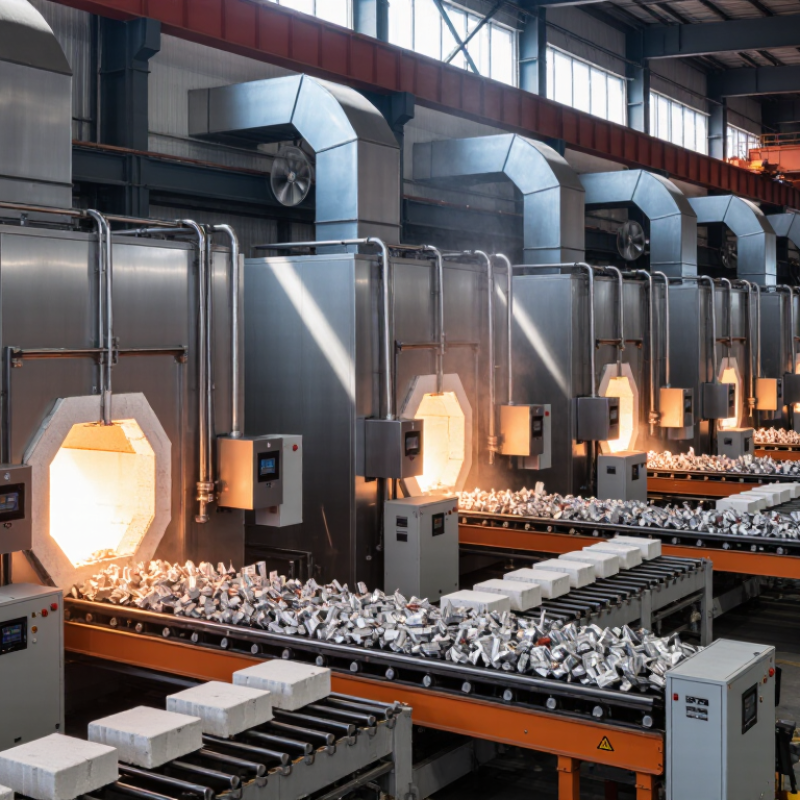
Definition and Role of Aluminum Scrap Melting Furnaces
An aluminum scrap melting furnace converts sorted scrap into reusable molten metal. It combines heat, controlled atmosphere, stirring, and temperature monitoring. The furnace also supports slag removal and alloy adjustment. These steps affect metal quality, energy use, and worker safety. According to the International Aluminium Institute, recycled aluminum requires about 5% of the energy used for primary aluminum production. That advantage makes furnace efficiency commercially important. It also explains the growing demand for reliable equipment.
In real operations, furnace design must match scrap type, charge density, contamination, and production volume. Reverberatory, rotary, and induction furnaces offer different balances between capacity, recovery rate, and operating cost. The U.S. Department of Energy’s Industrial Decarbonization Roadmap identifies secondary aluminum as an important pathway for reducing industrial energy demand. However, no furnace is universally best. A clean spreadsheet can still hide poor loading practices, excessive dross, or unstable temperature control. Experienced operators remain essential.
Tips: Check melting loss, energy consumption, filtration, refractory life, and automation before comparing manufacturers. Ask for measured operating data, not only catalogue claims. Inspect the furnace floor, charging zone, and exhaust points during a site visit. Small details matter. Scrap moisture and paint residues can change performance sharply. A lower purchase price may create higher maintenance costs later. The evaluation should include local service skills, spare-part access, and compliance with applicable environmental standards.
Key Criteria for Ranking Furnace Manufacturers
Top 10 Aluminum Scrap Melting Furnace Manufacturers
Key Criteria for Ranking Furnace Manufacturers
Ranking aluminum scrap melting furnace manufacturers requires more than comparing furnace size or purchase price. The International Aluminium Institute reports that recycled aluminum uses about 5% of the energy required for primary aluminum production. Therefore, thermal efficiency, metal recovery, and fuel consumption deserve strong ranking weight. A reliable furnace should maintain stable temperatures, reduce oxidation, and limit dross formation during repeated charging cycles.
Operational evidence matters more than impressive brochures. I would examine melting rates, recovery percentages, refractory service life, and unplanned downtime across comparable facilities. The U.S. Department of Energy’s Industrial Assessment data shows that industrial heating systems often offer measurable savings through improved combustion control and heat recovery. Furnace controls should record temperature trends, fuel use, power demand, and alarm history. Simple data is useful.
Safety and service quality also separate strong manufacturers from average suppliers. Ranking teams should verify emergency systems, operator access, spare-part availability, installation training, and response times. Total ownership cost should include maintenance, energy, consumables, and production losses. A low quotation may conceal expensive downtime. That mistake is common. Customer references should involve similar scrap grades, batch sizes, and working conditions. Even then, rankings remain imperfect because local energy prices and operator skill can change the result. A technically excellent furnace may underperform when charging practices are poorly controlled.
Top 10 Aluminum Scrap Melting Furnace Manufacturers
Choosing among the top 10 aluminum scrap melting furnace manufacturers requires more than comparing advertised tonnage. Furnace design must match scrap composition, moisture control, alloy targets, and hourly production. The International Aluminium Institute reports that recycled aluminum can require about 95% less energy than primary aluminum production. That figure makes combustion efficiency important, but it does not tell the whole story. Poor charging practice, excessive dross, and unstable temperature control can erase part of the benefit.
A credible manufacturer should provide measured fuel consumption, melting rates, emission-control data, and service records from comparable plants. The International Energy Agency estimates that aluminum production contributes roughly 2.5% of global energy-related carbon dioxide emissions. Efficient burners, regenerative heating, sealed charging systems, and effective filtration therefore deserve close attention. Small details matter. Ask about refractory life, sensor calibration, spare-part access, and operator training. A low purchase price may become expensive after repeated downtime.
I would not rank the top 10 manufacturers by brochure capacity alone. That approach is too simple. Independent acceptance testing should verify metal recovery, energy use, temperature uniformity, and emissions under real scrap conditions. Industry reports provide useful benchmarks, yet each factory behaves differently. Wet turnings, coated profiles, and mixed cast scrap can expose weaknesses quickly. The strongest suppliers explain these limitations clearly, although many comparisons still lack long-term operating data.
Furnace Technologies and Product Comparisons
Top 10 Aluminum Scrap Melting Furnace Manufacturers: Furnace Technologies and Product Comparisons
Comparing the top 10 aluminum scrap melting furnace manufacturers requires more than checking rated capacity. Rotary furnaces suit mixed, oily scrap and can improve metal recovery through controlled agitation. Reverberatory furnaces offer high throughput, but their large chambers may lose more heat during opening. Induction furnaces provide rapid melting and precise temperature control, although they demand clean, well-prepared charge materials. Tilting designs also simplify pouring and slag removal. Small details matter.
The International Aluminium Institute reports that recycled aluminum uses about 5% of the energy required for primary aluminum production. Therefore, furnace efficiency directly affects both operating cost and emissions. The U.S. Department of Energy identifies combustion control, insulation, and heat recovery as practical routes for reducing industrial furnace energy use. When comparing suppliers, buyers should examine specific fuel consumption, melting yield, refractory life, emissions controls, and temperature uniformity. A glossy efficiency figure is not enough. Ask how it was measured.
Real workshop conditions often change the ranking. Wet chips, painted scrap, and frequent alloy changes can reduce theoretical performance. A furnace rated for 2,000 kilograms per hour may deliver less when charging becomes irregular. The World Bank’s Commodity Markets Outlook also shows continuing volatility in industrial energy prices, making stable fuel consumption increasingly important. In my view, the strongest comparison combines factory trials, maintenance records, and operator feedback. Manufacturer data can be useful, but it is rarely the whole story.
How to Select the Right Manufacturer for Your Needs
Choosing among the top 10 aluminum scrap melting furnace manufacturers requires more than comparing prices. Define your actual workload first. Record daily scrap volume, alloy types, batch size, target temperature, and available floor space. A furnace designed for clean extrusion scrap may struggle with painted or mixed material. Ask each manufacturer for documented melt-rate data under similar conditions, not only laboratory figures.
Inspect the heating method carefully. Gas, electric, and regenerative systems have different energy demands, maintenance needs, and installation requirements. Review temperature uniformity, burner control, refractory life, charging design, and dross handling.
Small details matter. Measure twice.
Experienced manufacturers should provide drawings, utility calculations, safety documentation, and commissioning support. Request references from plants with comparable production schedules. Speak with operators, not only sales representatives. Ask how quickly spare elements, sensors, and refractory parts can be supplied. A low purchase price becomes less attractive when one failed component stops production for several days.
Check the control system before signing. Data logging can reveal energy waste, unstable temperatures, and repeated charging problems. Require performance testing with your own scrap whenever possible. I would not rely on a polished demonstration using ideal material. Real scrap is inconsistent, and furnace performance can change sharply with moisture, coatings, and contamination. A perfect specification rarely exists. Leave room for operator feedback, future capacity, and maintenance access. Review warranty limits, training scope, local service capability, and compliance responsibilities in writing.


