











Why Choose a Brackish Water RO System?
Brackish water can look clear in a glass, yet contain enough dissolved salts to limit its use for drinking, irrigation, or industrial processes. A Brackish Water Ro System is designed to reduce these dissolved minerals by pushing feedwater through specialized membranes under pressure. The result can be useful, but performance depends on the water entering the system. Appearance alone tells you little.
A reliable choice starts with a water analysis. Conductivity, hardness, silica, and iron levels can affect membrane selection, pretreatment, and operating costs. For example, untreated hardness may contribute to scale, while sediment can clog cartridge filters. Small details matter. A properly selected system can provide consistent permeate, but it still needs routine monitoring, cleaning, and replacement parts. No unit runs itself.
This guide explains why businesses and property owners consider brackish-water reverse osmosis, how the process works, and what to check before choosing equipment. It also looks at practical trade-offs, including water recovery, energy use, maintenance, and feedwater variation. Capacity figures deserve a closer look: actual output may change with temperature, pressure, and water chemistry. It is easy to focus on the rated flow and overlook these conditions. That can be a costly mistake. The right system is not always the largest or most advanced; it is the one matched to measured water quality and a realistic operating plan.
Understanding Brackish Water and Its Treatment Challenges
Brackish water contains more dissolved salts than freshwater, but far less than seawater. It may come from wells, inland aquifers, or streams influenced by local geology and irrigation. Its chemistry can vary between nearby sites. A clear sample may still contain dissolved minerals, silica, iron, or organic matter. Looks clean. Testing matters. A laboratory analysis should measure total dissolved solids and individual ions, along with turbidity and other relevant water-quality indicators. Salinity alone does not reveal the full treatment challenge.
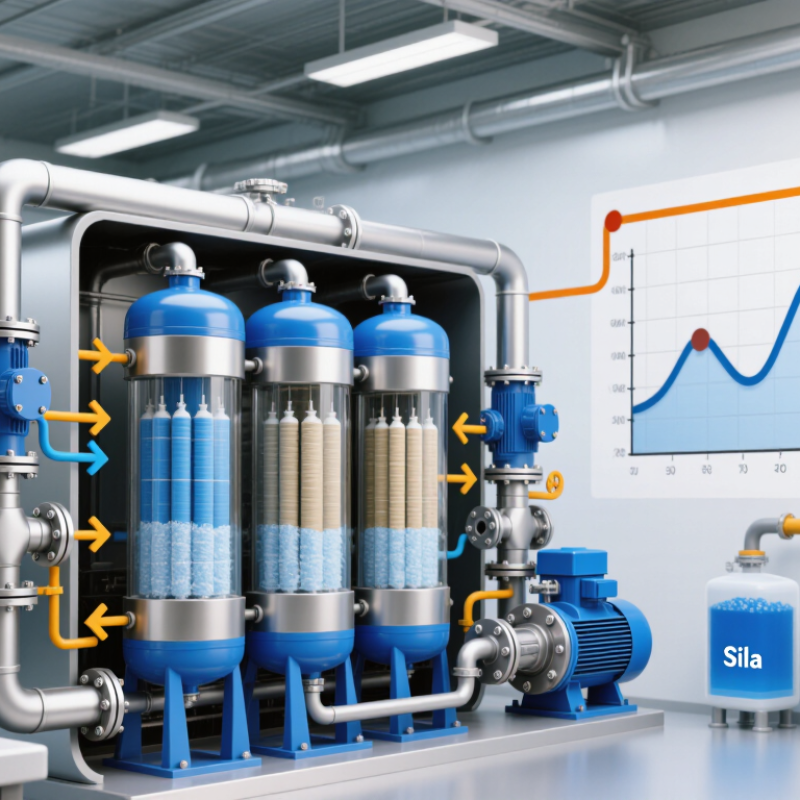
A brackish water reverse osmosis system pushes feed water through a membrane under pressure, reducing many dissolved salts. The right operating pressure depends on the water’s composition and the membrane selected. Calcium, sulfate, and silica can form scale, while suspended particles and organics may foul the membrane. Pretreatment and regular monitoring help manage these risks, but they cannot compensate for incomplete water testing. There is no fixed recipe. Operators also need to consider recovery rates and how concentrated reject water will be handled. Even well-designed systems need adjustment as feed-water quality changes; that part is easy to underestimate.
Why Choose a Brackish Water RO System? - Understanding Brackish Water and Its Treatment Challenges
| Design Dimension | Typical Brackish-Water RO Consideration | Why It Matters |
|---|---|---|
| Feed-water salinity | Brackish water is commonly described as having about 1,000–10,000 mg/L total dissolved solids (TDS); actual classifications vary. | Salinity affects the pressure required, salt passage, recovery limits, and the overall treatment design. |
| Operating pressure | Many brackish-water RO applications operate at approximately 10–25 bar (about 145–363 psi), depending on feed chemistry and membrane selection. | RO must apply enough pressure to overcome the feed-water osmotic pressure. Higher salinity generally requires higher operating pressure. |
| Salt rejection | RO membranes commonly achieve roughly 95–99% salt rejection under specified test conditions; actual system performance varies. | Rejection determines how much dissolved salt passes into the permeate. System design and operating conditions affect the result. |
| Illustrative permeate TDS | At 2,000 mg/L feed TDS and 98% salt rejection, the estimated permeate TDS is about 40 mg/L. | This is a simplified calculation, not a guaranteed product-water value. Individual ions may pass through at different rates. |
| Water recovery | Recovery is often designed within a broad range of about 50–85%, depending on feed-water quality, pretreatment, and system configuration. | Higher recovery reduces concentrate volume but also increases the concentration of dissolved salts in the reject stream, which can raise scaling risk. |
| Scaling and fouling risk | Calcium carbonate, calcium sulfate, silica, iron, suspended solids, and organic matter may require control, depending on the source water. | Deposits and fouling can reduce permeate flow, increase pressure requirements, and lead to more frequent cleaning or membrane replacement. |
| Pretreatment needs | May include sediment filtration, cartridge filtration, pH adjustment, antiscalant dosing, iron or manganese removal, and disinfection management. | Pretreatment should be selected from a water analysis and designed to protect the membranes from particles, scale, and incompatible chemicals. |
| Energy demand | Energy use varies substantially with salinity, pressure, recovery, equipment efficiency, and system boundaries; brackish-water RO generally requires less pressure than seawater RO. | Lower feed-water salinity can reduce pumping requirements, but energy estimates should be based on the complete application and operating conditions. |
| Concentrate management | The reject stream contains concentrated dissolved salts and may also contain constituents removed during pretreatment. | Disposal or reuse options must comply with local requirements and be evaluated for site conditions and concentrate composition. |
| Best-fit applications | Common uses include groundwater desalination, industrial process water, and treatment of lower-salinity sources where dissolved salts must be reduced. | A brackish-water RO system can be a practical choice when source-water analysis confirms that its pressure, recovery, and pretreatment needs are suitable. |
Note: The ranges shown are general engineering references, not design guarantees. A representative water analysis and site-specific design are needed to determine operating conditions, recovery, and treated-water quality.