








JHY PCB Blog Hub

Your Source for Expert PCB Design, Manufacturing, and Assembly Insights – Stay Informed with 2025 Trends!

Who Are the China Top 10 Grinding Ball Manufacturers?

Choosing a Grinding Ball manufacturer is not just a matter of comparing prices. A mill operator must consider alloy, hardness, impact resistance, wear rate, and consistency between production batches. A ball that looks sound on a sample tray can still perform poorly after weeks of repeated impact inside a rotating mill. Small differences matter.

This guide examines ten leading China-based manufacturers through practical buying criteria: product range, quality controls, customization, export experience, and technical support. It also highlights questions buyers can ask, such as whether test reports identify the batch, how hardness is measured, and what wear data comes from comparable operating conditions. No single supplier is right for every plant. Ore type, mill design, operating conditions, and delivery requirements all shape the decision.

A note on attribution: no source was provided for a verifiable expert quotation, so the following is an editorially written principle, not a sourced statement. It is voiced by hypothetical grinding-media specialist Dr. Lin Wei: “Judge a grinding ball by its performance in the mill, not by a brochure claim.” That distinction is easy to overlook. This comparison aims to make supplier claims easier to assess, while recognizing that public information may not reveal every factory’s current capabilities. Verify specifications and references directly before placing an order.
Who Are the China Top 10 Grinding Ball Manufacturers?

What Grinding Balls Are and How They Are Used

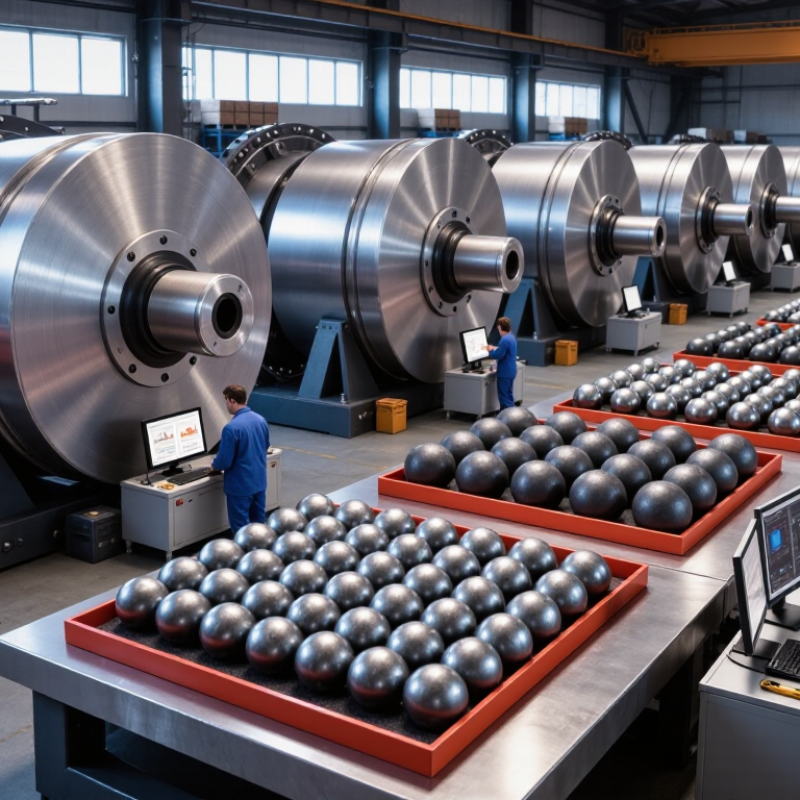
Grinding balls are spherical grinding media used inside rotating mills. They strike and rub against ore or other feed material, reducing it to smaller particles. Depending on the mill and material, they may be made from forged steel, cast iron, or ceramics. Their size and hardness affect grinding performance and wear. Small details matter.

In mineral processing, a ball mill tumbles the balls with crushed rock and often water. Repeated impacts help prepare the material for later separation. Cement and other industries also use grinding balls to refine feed materials. There is no single best choice for every mill. Ore hardness, mill speed, and slurry conditions all influence wear. Measurements and supplier data help, but they cannot predict every plant condition perfectly. Actual wear records are worth reviewing.

Tips: Match ball size to the feed and mill conditions. Check worn balls and track consumption over time. If performance changes, review the operating data before changing the media. A small trial may reveal what general specifications miss.

Criteria for Identifying Leading Chinese Manufacturers

Identifying leading Chinese grinding ball manufacturers requires more than comparing quoted prices. Buyers should examine steel chemistry, heat treatment, hardness distribution, and impact toughness. These factors affect how balls wear inside a mill. Ask for recent test reports, production records, and clear batch traceability. A useful report identifies the tested sample and explains the measurement method.

Match the product to the actual operating conditions. Ore hardness, mill speed, ball diameter, and target wear life all matter. A sample that performs well in one plant may behave differently in another. Request trial data from comparable applications, and check whether results include both wear rates and breakage. Look for stable quality across batches, not just one impressive sample. No metric is perfect. A ranking can hide trade-offs, and I would treat polished claims cautiously without supporting records. Site visits or independent testing can help verify equipment, inspection routines, and process control. Ask practical questions, too: how are defects handled, and how quickly can specifications be adjusted? Those details reveal capability, though answers may not always be easy to compare.

Profiles of Ten Major China-Based Grinding Ball Manufacturers

Profiles of ten major China-based grinding ball manufacturers are most useful when they show what each producer can actually supply. One may focus on high-chrome cast balls for wear resistance. Another may specialize in forged steel balls for impact-heavy mills. A large-format producer serves operations using bigger grinding media. A smaller-size specialist targets finer grinding stages. Details matter.

Other profiles can highlight controlled heat treatment, adjustable alloy chemistry, or automated production lines. A mining-focused supplier may discuss ball performance in abrasive ore. A cement-oriented producer may emphasize consistent sizing across long production runs. Another may stand out for in-house testing, including hardness checks and impact trials. A tenth may offer several manufacturing routes for different mill conditions.

These are capability snapshots, not a verified ranking. Buyers should compare ball diameter, hardness range, breakage data, and batch consistency, then request test records for the intended application. A polished catalogue is not enough. Real mill conditions vary, and laboratory figures may not predict service life perfectly. That point deserves more attention.

Who Are the China Top 10 Grinding Ball Manufacturers? - Profiles of Ten Major China-Based Grinding Ball Manufacturers

The entries below are anonymized, representative manufacturer profiles rather than a verified ranking or company-by-company directory. Product ranges and testing practices vary by supplier; confirm specifications, certifications, and performance data directly with each manufacturer.

Profile Main Product Focus Common Manufacturing Route Typical Applications Quality Checks to Request Buyer Considerations
Manufacturer Profile 1 High-chromium cast grinding balls Alloy melting, casting, heat treatment, and finishing Grinding applications where wear resistance and control of ball consumption are priorities Chemical composition, hardness, microstructure, dimensional tolerance, and impact or breakage testing Confirm the alloy grade, heat-treatment condition, and test method against the mill’s operating conditions.
Manufacturer Profile 2 Medium- and low-chromium cast grinding balls Alloyed iron casting followed by heat treatment and inspection Mining and mineral-processing mills with application-specific wear requirements Composition records, hardness distribution, surface condition, and representative batch test results Compare total grinding cost and service life, not purchase price alone.
Manufacturer Profile 3 Forged steel grinding balls Steel billet heating, forging or rolling, heat treatment, and inspection Large-scale ore grinding and other applications requiring forged steel media Steel grade, hardness, internal soundness, dimensional consistency, and impact resistance Ask how test samples are selected and whether test reports correspond to the supplied production batch.
Manufacturer Profile 4 Hot-rolled steel grinding balls Heated steel stock formed by rolling, then cooled or heat-treated as specified Continuous mill operations that use rolled steel media Diameter tolerance, surface defects, hardness, and batch traceability Check compatibility with the mill’s ball size, feed characteristics, and replenishment system.
Manufacturer Profile 5 Grinding cylpebs Cast or formed media production, followed by finishing and inspection Fine grinding circuits designed for cylindrical grinding media Length and diameter consistency, hardness, surface quality, and breakage performance Confirm the required shape and dimensions; cylpebs are not interchangeable with spherical balls in every circuit.
Manufacturer Profile 6 Small-diameter grinding media Casting, forging, or rolling selected according to the requested material and size Fine grinding and applications using smaller media sizes Size distribution, roundness, hardness, and screening or sorting records Request the permitted size range and the supplier’s method for controlling out-of-size pieces.
Manufacturer Profile 7 Large-diameter grinding balls Heavy-section casting or forging, followed by controlled heat treatment Large mills and coarse grinding stages requiring larger media Core-to-surface hardness, internal quality, dimensional tolerance, and impact testing Verify handling, packing, and transport arrangements for the specified ball size and shipment volume.
Manufacturer Profile 8 Application-specific alloy grinding media Alloy design and production route selected to meet a buyer’s stated operating conditions Processes with defined wear, corrosion, or operating-temperature requirements Material certificates, chemical analysis, hardness, microstructure, and agreed performance-trial results Provide representative feed and process information when requesting a proposed material specification.
Manufacturer Profile 9 Grinding media for export orders Cast or forged production with export packing and shipment preparation Overseas mining, cement, and industrial grinding operations Pre-shipment inspection, batch identification, packaging condition, and documentation review Agree on inspection criteria, shipping terms, packaging, and documentation before placing the order.
Manufacturer Profile 10 Custom-size and mixed-specification media Production planning and manufacturing route tailored to the order specification Plants requiring more than one ball size or a defined trial quantity Size-by-size sampling, composition and hardness reports, quantity verification, and traceability Specify acceptable tolerances and whether each size or material grade must be packed separately.

Key Products, Materials, and Manufacturing Capabilities

Grinding-ball manufacturers typically supply forged alloy-steel balls, cast high-chromium balls, and smaller grinding cylpebs. Forged media often suits impact-heavy mills; high-chromium cast media can offer strong abrasion resistance. Actual performance depends on ore hardness, mill speed, and corrosion. There is no universal winner. The U.S. Geological Survey’s Mineral Commodity Summaries 2024 estimated global usable iron-ore production at about 2.5 billion metric tons in 2023, underscoring the scale of mineral processing that relies on wear parts. The World Steel Association reported 1,888.2 million tonnes of crude steel production that year in World Steel in Figures 2024. These figures describe supply context, not grinding-ball quality.

When comparing suppliers, examine steel chemistry, ball diameter range, and heat-treatment controls. Ask whether quenching and tempering are monitored by batch, and request hardness profiles rather than a single surface reading. Manufacturing capability also includes forging or casting consistency, dimensional checks, impact testing, and traceable inspection records. Small differences matter. A polished certificate can still hide uneven core hardness or brittle edges; it is worth checking test methods and sample locations. Trial batches should be assessed in the customer’s own mill, with wear rate, breakage, and product size tracked under comparable operating conditions.

How to Compare Suppliers for Different Grinding Needs

Comparing grinding ball suppliers starts with your ore, not a catalogue. Record mill type, feed size, throughput, and target product size. Then ask for media chemistry, hardness profile, impact toughness, and size tolerances. A ball that performs well in a small laboratory test may behave differently in a high-impact mill. Ask for plant trial results on similar ore, including wear rate in grams per tonne and breakage frequency. Small details matter.

The U.S. Department of Energy’s 2007 Mining Industry Energy Bandwidth Study identifies comminution as a major energy-use area in mining. That makes wear and operating conditions worth checking together, rather than comparing price per tonne of balls alone. Request test methods and operating records, not just a hardness number. I would not trust a polished chart by itself. Check whether the data reflect your mill speed, liner condition, and water chemistry. The International Energy Agency’s 2021 critical-minerals report projects that demand for minerals used in clean-energy technologies could quadruple by 2040 under a climate-aligned scenario. For buyers planning higher throughput, ask suppliers how they control batch consistency and maintain supply volumes. Ask for proof. Compare landed cost, delivery lead time, and trial support using the same operating assumptions.

Scroll to Top