









What Is the Best Spy Camera Detector in 2026?
Choosing the best Spy Camera Detector in 2026 requires more than comparing prices, detection ranges, or glowing product reviews. Hidden-camera risks now intersect with smart-home devices, wireless networks, and increasingly compact imaging hardware. Pew Research Center reported in 2023 that 81% of Americans believe data-collection risks outweigh the benefits. That concern gives privacy tools a serious role, even in ordinary places such as hotel rooms, rental apartments, and changing areas.
Industry guidance also warns against trusting one detection method. ENISA’s 2024 Threat Landscape highlights continuing security risks across connected devices, while NIST’s IoT guidance emphasizes device awareness, secure configuration, and network monitoring. These principles matter because a detector may identify radio signals but miss a wired camera. Another model may reveal a lens reflection but struggle beside a bright window. No detector is magic.
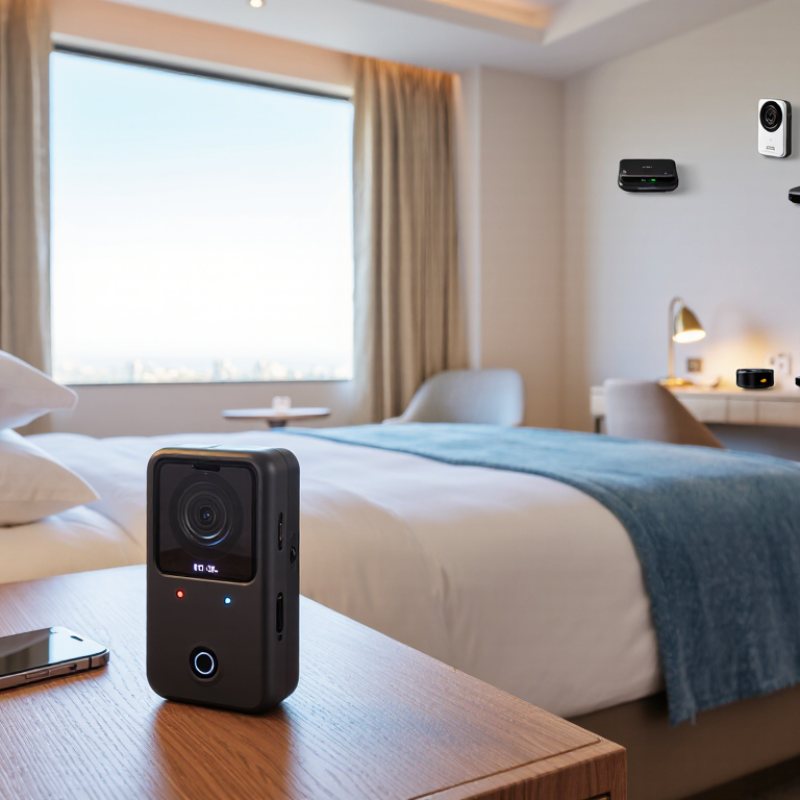
Real-world testing should therefore examine several details: signal stability, lens-finding performance, false alarms, battery life, and ease of use. A device that fits beside a phone and provides clear vibration feedback may be more useful than a powerful-looking model with confusing controls. Reviewers should also verify manufacturer claims, inspect privacy policies, and repeat tests in different lighting conditions. This article compares leading options through practical experience, technical evidence, and independent reporting. Some results may remain imperfect. That is important. A responsible recommendation should explain uncertainty, not hide it.
Classify Spy Cameras by IEEE 802.11 Wi‑Fi Bands and RF Emissions
What Is the Best Spy Camera Detector in 2026?
Classify Spy Cameras by IEEE 802.11 Wi-Fi Bands and RF Emissions
The best detector in 2026 should identify radio behavior, not simply beep near electronics. IEEE 802.11 devices commonly operate in the 2.4 GHz, 5 GHz, and 6 GHz bands. Wi-Fi 6E equipment can also appear in the 6 GHz range. A reliable detector should display frequency, signal strength, and changing activity over time.
Look for a spectrum view, adjustable sensitivity, and a directional antenna. These features help separate a possible camera signal from a nearby router, phone, or wireless speaker. In practical room checks, walk slowly around outlets, smoke alarms, lamps, and ceiling fixtures. Watch for short bursts instead of trusting one loud reading.
RF evidence is not proof by itself. Some cameras transmit through Wi-Fi, while others use different radio systems. Some store recordings locally and emit nothing during inspection. Bluetooth, cellular signals, and household electronics may also create false alerts. Quiet rooms help, but they do not guarantee accurate results.
A useful test records the same area several times. Compare readings with Wi-Fi devices switched off, when permitted. That comparison can expose background signals. Still, results may remain imperfect. Human interpretation matters, and I would not treat an inexpensive meter as final evidence. Pair RF analysis with a visual inspection and careful documentation. Short bursts can be misleading. Oscillating signals deserve closer attention.
What Is the Best Spy Camera Detector in 2026? - Classify Spy Cameras by IEEE 802.11 Wi‑Fi Bands and RF Emissions
A radio-frequency detector can reveal active transmissions, but an RF signal alone cannot establish that a device is a camera. Use the bands and signal characteristics below as a screening guide, then verify any finding with a physical inspection.
| Signal class | Frequency range | Relevant standards or services | Typical RF behavior | What a detector may indicate | Important limitation |
|---|---|---|---|---|---|
| 2.4 GHz Wi‑Fi | 2,400–2,483.5 MHz in many regulatory domains | IEEE 802.11b/g/n/ax; 802.11be can also operate in this band | May appear as recurring or burst-like digital transmissions on a Wi‑Fi channel. Activity can rise during live video streaming or data transfer. | Energy or channel activity in the 2.4 GHz band; a Wi‑Fi analyzer may help identify access points and channel use. | This band is shared with Bluetooth and many other devices. A signal does not identify its source or prove that a camera is present. |
| 5 GHz Wi‑Fi | Common allocations are approximately 5.15–5.85 GHz; permitted channels vary by country. | IEEE 802.11a/n/ac/ax; 802.11be can also operate in this band | Digital Wi‑Fi transmissions occur on assigned channels and may be intermittent, depending on device activity and network settings. | A detector covering the relevant 5 GHz channels may show transmission activity; a Wi‑Fi scan can provide more context about nearby networks. | Some channels are subject to local restrictions or radar-sharing requirements. A basic RF detector may not identify the protocol or device. |
| 6 GHz Wi‑Fi | Regulatory availability differs. For example, the United States permits 5,925–7,125 MHz; the European Union makes 5,945–6,425 MHz available for Wi‑Fi. | IEEE 802.11ax (Wi‑Fi 6E) and IEEE 802.11be (Wi‑Fi 7) | Digital transmissions use channels in the locally authorized portion of the band. A compatible device and detector are required to observe them. | A wideband RF instrument or 6 GHz-capable Wi‑Fi analyzer may detect activity within its supported frequency range. | Many general-purpose detectors do not cover 6 GHz. Absence of a reading does not rule out a device transmitting in this band. |
| Bluetooth and other 2.4 GHz signals | Bluetooth operates in the 2,402–2,480 MHz range. | Bluetooth; not IEEE 802.11 Wi‑Fi | Bluetooth devices use short, frequency-hopping transmissions that may be brief or irregular. | A broadband detector may show activity in the same general range used by 2.4 GHz Wi‑Fi. | Bluetooth activity is not evidence of a camera. RF-only tools may not reliably distinguish it from other nearby 2.4 GHz sources. |
| Cellular or other non‑Wi‑Fi radio | Varies by country, carrier, and radio technology; there is no single universal frequency range. | Cellular networks and other licensed or unlicensed radio services; not IEEE 802.11 Wi‑Fi | Transmission timing and frequency depend on the network, device, and connection state. | A suitable spectrum analyzer may show energy in a supported frequency range. | Nearby phones, routers, and other equipment can produce readings. Frequency activity alone cannot identify a camera. |
| No detectable RF transmission | No active radio signal may be present during the inspection. | Local storage, wired operation, powered-off equipment, or a device that transmits only occasionally | There may be no measurable wireless emission, or transmissions may occur only at particular times. | An RF detector may show no relevant activity. | No RF reading does not rule out a camera. RF screening should be combined with a careful visual and physical inspection. |
Practical interpretation: The most useful detector is one whose supported frequency range matches the bands being checked and that can distinguish signal activity from background noise. IEEE 802.11 bands and permitted channels vary by regulatory region; always confirm local frequency rules. RF measurements are screening evidence, not definitive identification.