











JHY PCB Blog Hub
Your Source for Expert PCB Design, Manufacturing, and Assembly Insights – Stay Informed with 2025 Trends!
How to Find the Best LED Mood Light Manufacturer in China?
Finding the right LED Mood Light Manufacturer in China takes more than comparing prices or browsing polished product photos. A warm bedside glow may look simple, yet its performance depends on details such as LED consistency, dimming response, housing materials, and heat management. Ask how the factory tests brightness and color variation, and request samples in the exact finish and configuration you plan to order. Small differences show up quickly in a dark room.
Clear communication matters. A dependable supplier should explain available customization, minimum order quantities, sample costs, and production timelines without hiding important conditions. Ask for product specifications and relevant quality documentation, then check that they match the sample and the quotation. If a factory is slow to answer basic questions, that is useful information. Not proof, but a signal.
This guide outlines practical ways to assess manufacturers, compare offers, and reduce avoidable sourcing risks. You will learn what to inspect in a sample, which questions to raise before production, and how to evaluate packaging and after-sales support. Trade-show visits and video calls can help, but neither replaces careful verification. Some buyers focus too heavily on the unit price; I have seen that decision create problems later, especially when color, controls, or packaging differ from expectations. There is no perfect checklist, and supplier claims still need checking. A measured process helps you choose a partner whose products suit your market, budget, and customer expectations.
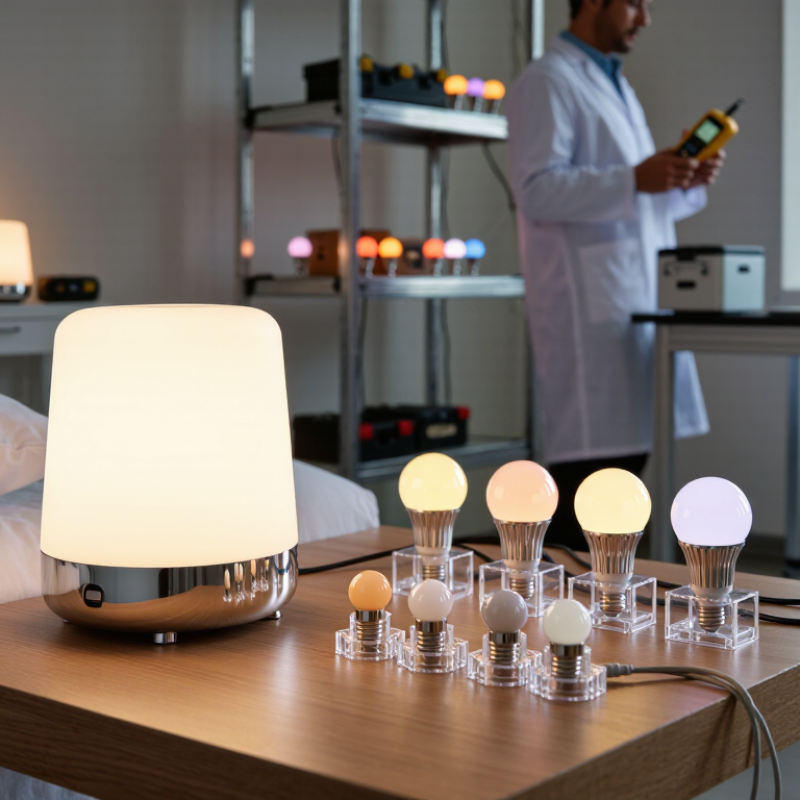
Define Mood-Light Requirements: RGB/RGBW, 2700–6500 K CCT, and Control Options
Define the light’s job before comparing manufacturers. For a reading corner, warm white near 2700 K can feel comfortable; a work area may benefit from cooler settings up to 6500 K. Confirm that the manufacturer’s stated CCT range applies across the full dimming range, not just at maximum brightness. Ask for sample measurements and a physical sample, since white tones can look different on a screen.
RGB creates colored light, while RGBW adds a dedicated white channel that can produce more useful everyday illumination. If accurate whites matter, ask how the RGBW channels mix and whether color changes cause visible flicker. Small detail, big difference.
Specify control options too: remote, wall control, app, or integration with your existing system. Check pairing steps, dimming behavior, and what happens after a power cut. It is easy to request every feature, then discover the controls feel confusing.
Test a sample in the room, at night and in daylight. Still, this choice deserves a second look. Compare the sample against your actual use, not only a specification sheet.
Compare LED Quality Metrics: CRI ≥80, Dimming Range, and Rated Lifetime
When evaluating a China-based LED mood light manufacturer, compare measured performance, not just attractive specification sheets. A color rendering index (CRI) of 80 or higher is a useful baseline for natural-looking colors. Ask whether the figure is typical or guaranteed, and request test data for the actual light source. CRI alone has limits; red objects can still look dull, so check R9 performance when color accuracy matters. Test a sample beside familiar objects. Small differences show.
Dimming should feel smooth from low to full brightness, without visible flicker, sudden jumps, or unwanted color shifts. Ask for the usable dimming range and confirm which control method was tested. Try the light at its lowest setting in a dim room, where faults are easier to notice. A wide stated range may sound impressive, but the bottom few percent can be unstable. That detail is often missed.
Rated lifetime needs context. Check whether the manufacturer reports L70 life, meaning the point when output falls to 70 percent, and ask about test conditions. Also check the driver rating; a long-lived LED is of little help if its power supply fails early. Request reports tied to the offered model, then compare them with your sample test. I would not treat a single number as a promise. Real use varies with heat, operating hours, and ventilation.
How to Find the Best LED Mood Light Manufacturer in China?
Compare practical LED quality screening benchmarks for CRI, dimming range, and rated lifetime.
These are illustrative procurement benchmarks, not universal standards or brand test results. Ask manufacturers for test reports and datasheets. Confirm CRI under stated test conditions, check dimming performance across the full range, and verify how rated lifetime is defined (for example, L70 hours).
Verify Luminaire Safety Against IEC 60598-1 and IEC 62471
When evaluating an LED mood light manufacturer in China, ask how each finished luminaire is checked against IEC 60598-1. This standard covers general safety requirements, including construction, wiring, insulation, and testing. Request a test report for the exact model, not merely a similar product. The report should identify the sample, rating, and test conditions. Small details matter. A loose cable entry or sharp edge can signal weak quality control.
Also verify photobiological safety under IEC 62471. LED brightness and viewing distance affect exposure assessment, so ask for the applicable risk-group classification and supporting test data. A colored diffuser may soften the glow, but it does not replace testing. Compare the report’s model number and LED configuration with the unit you plan to order. If the supplier changes LEDs or optics, ask whether reassessment is needed.
A tidy PDF is not proof by itself. Check whether the issuing laboratory and report details can be independently verified, and clarify which production checks are repeated. I would still inspect samples: documents can miss a badly fitted shade or inconsistent wiring. Ask for dated photos, inspection records, and a clear explanation of any test limitations before approving a bulk order.
Audit Factory Quality Systems, Including ISO 9001 Certification and Test Records
An ISO 9001 certificate is a useful starting point, not proof that every mood light will perform well. The ISO Survey 2022 recorded about 1.27 million valid ISO 9001 certificates across 189 countries. This widespread use makes verification essential: check the certificate’s current status, named factory, and production scope. A trading office’s certificate may not cover the workshop making your lights. Ask how staff control supplier changes, defects, and corrective actions.
Inspect real test records, not just a polished quality manual. For a sample production lot, trace LED components, drivers, and plastic housings from incoming inspection to final release. Review electrical, lighting, aging, and temperature test results, including failed samples and the actions taken afterward. Check that measuring equipment has current calibration records. Photometric reports should identify the tested model and test date. A neat binder can still hide gaps; compare records with the actual product line and recent batch numbers.
Tips: Request dated records from the last three months, then choose a batch number and follow it through the factory’s logs. Ask to see one failed test and its follow-up. If every record looks perfect, ask how the factory documents exceptions. That question can feel awkward, but it is useful.
How to Find the Best LED Mood Light Manufacturer in China? — Audit Factory Quality Systems, Including ISO 9001 Certification and Test Records
| Audit Dimension | Evidence to Review | What to Check | Audit Result | Follow-Up |
|---|---|---|---|---|
| Quality management system | Current quality manual or process map, internal audit records, management review minutes, and corrective-action records. | Confirm that documented processes cover purchasing, production, inspection, nonconforming products, and corrective action. Sample records should show issues were investigated and closed. | To be verified | Review a recent completed corrective action from detection through effectiveness check. |
| ISO 9001 certification | Certificate showing the legal entity, site address, certification scope, standard edition, issue date, expiry date, and certification body. | Verify certificate status directly with the certification body or its official directory. Confirm that the audited site and relevant manufacturing activities fall within the stated scope. Certification alone does not establish product compliance. | To be verified | Request the certificate and independently confirm its validity and scope. |
| Document and record control | Controlled procedures, revision history, inspection forms, and retained production and test records. | Check that employees use current document revisions and that records are legible, dated, attributable to an operator or inspector, and retrievable by product or batch. | To be verified | Trace one finished-product batch back to its inspection and production records. |
| Incoming-material inspection | Supplier specifications, incoming inspection reports, component identification, and nonconforming-material records. | Check how key components such as LED modules, power supplies, cables, connectors, and plastic housings are identified and inspected against documented requirements. | To be verified | Compare a recent incoming inspection record with the related component specification. |
| Production process controls | Work instructions, process parameters, operator training records, and in-process inspection results. | Confirm that assembly and wiring steps have clear instructions and that relevant checkpoints are recorded. Check how process changes and deviations are approved and documented. | To be verified | Observe a production operation and compare it with the current work instruction. |
| Final inspection and traceability | Finished-product inspection plans, pass/fail records, batch or serial identification, and release authorization. | Confirm that inspection criteria are defined before shipment and that sampled units can be linked to their production batch, inspection results, and release decision. | To be verified | Select a recent batch and trace its identification through final inspection and shipment release. |
| Electrical and functional testing | Test procedures and records for functions relevant to the product, such as power-on, dimming, color modes, controls, and charging where applicable. | Check that test conditions and acceptance criteria are documented, results are recorded, and failures are segregated and dispositioned. Confirm that the test setup matches the product configuration. | To be verified | Witness a test on a representative unit and compare the result with its recorded criteria. |
| Safety and market compliance | Applicable test reports, product specifications, declarations, and destination-market compliance documentation. | Confirm that standards and requirements are selected for the product type and destination market. Depending on the design and market, relevant standards may include IEC 60598, IEC 62471, or applicable EMC requirements. Check report model details and configuration against the product offered. | To be verified | Match the tested model, components, and report scope to the production model and target market. |
| Measurement equipment | Equipment inventory, calibration certificates, calibration status labels, and out-of-tolerance investigation records. | Check that instruments used for acceptance decisions are suitable for their purpose, within their calibration period, and traceable to recognized measurement standards where applicable. | To be verified | Choose a test instrument and verify its identification, calibration status, and latest certificate. |
| Nonconforming products and corrective action | Rejection logs, rework or scrap records, root-cause analyses, and corrective-action effectiveness checks. | Confirm that failed products are identified and controlled to prevent unintended shipment, and that recurring issues are analyzed rather than merely re-inspected. | To be verified | Review one recent quality issue and verify the documented containment and resolution. |
| Supplier and change control | Approved-supplier records, supplier evaluations, engineering change notices, and customer approvals where required. | Check how changes to components, materials, firmware, or manufacturing processes are reviewed for quality and compliance impact before implementation. | To be verified | Trace one component or process change from approval to updated production documentation. |
| Customer complaints and warranty feedback | Complaint logs, returns analysis, response records, and trend summaries. | Confirm that complaints are recorded, investigated, and linked to corrective action where appropriate. Check whether repeat issues and product-family trends are reviewed. | To be verified | Review a recent complaint and trace its investigation, response, and any resulting action. |
Audit note: “To be verified” indicates that the evidence must be checked during document review or an on-site audit; it is not a finding about any particular factory. Applicable standards and legal requirements depend on the product design and destination market.
Evaluate Samples, MOQ, Lead Times, and Export Support Before Selecting a Manufacturer
When comparing LED mood light manufacturers in China, request samples made with the same materials and process as the planned order. Check color consistency, dimming response, diffuser finish, and whether the light flickers at low brightness. Run the sample for several hours; note heat around the housing and any loose connectors. Looks can deceive. Ask for a revised sample if a control setting or finish feels unfinished, and record the agreed specifications before approving production.
Confirm the minimum order quantity (MOQ) for each model and whether custom colors or packaging change it. A low MOQ may still come with higher unit costs, so compare the full quotation, not just the headline price. Request separate timelines for sample making, production, and shipment readiness. Ask what could extend them, such as component shortages or packaging changes. Get export support details in writing: available shipping options, carton dimensions, packing lists, and destination-specific documents or test records. Clear answers matter. If dates sound unusually precise before the design is approved, ask how delays are handled. I would not treat a polished sample as proof that every batch will match; agree on inspection points and acceptable color variation before placing the order.


