Best Industrial Gripper Manufacturer in China?
Choosing the best Industrial Gripper manufacturer in China requires more than comparing catalog prices. The right partner must understand your application, production rhythm, and long-term reliability needs. A gripper used on a six-axis robot may handle metal parts, plastic components, or delicate electronic housings. Each task demands different jaw materials, gripping forces, stroke lengths, and response times.
Experienced manufacturers usually begin with practical questions. What is the part weight? How often does the gripper cycle? Is dust, oil, heat, or vibration present? These details reveal whether a pneumatic, electric, or custom solution is suitable. Strong suppliers can provide drawings, sample testing, technical calculations, and integration support. They should also explain repeatability, payload limits, maintenance requirements, and replacement-part availability.
However, no supplier is perfect. A polished website does not prove factory capability. A low quotation may hide weak testing or limited engineering support. Buyers should inspect production records, quality procedures, customer references, and sample performance. Ask for realistic cycle tests, not only laboratory demonstrations. Small failures matter. A loose jaw, delayed sensor, or poorly finished mounting surface can stop an entire line.
The most reliable Chinese manufacturer combines engineering experience with transparent communication. It listens carefully, documents changes, and accepts responsibility when improvements are needed. Certifications can support trust, but practical evidence matters more. The best choice is not always the largest factory or the cheapest option. It is the manufacturer that delivers a stable Industrial Gripper, responds clearly, and keeps improving after installation.
Industrial Grippers: Definition, Functions, and Main Applications
Industrial Grippers: Definition, Functions, and Main Applications
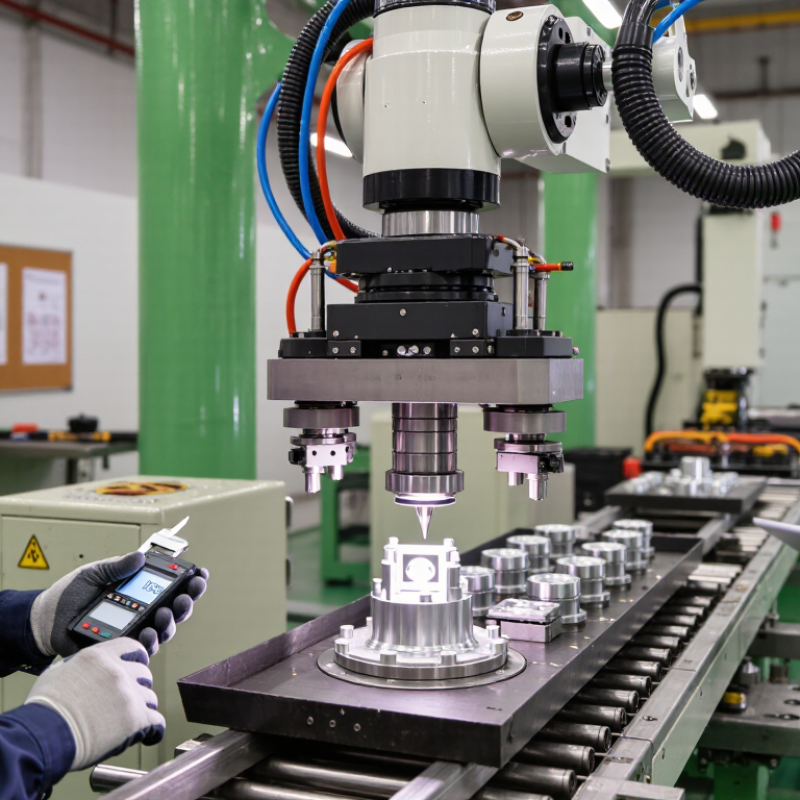
An industrial gripper is a robot-mounted device that holds, positions, or releases a workpiece. It acts as the robot’s mechanical hand. Common types include parallel-jaw, three-finger, vacuum, magnetic, and soft grippers. Each design suits different materials, shapes, weights, and surface conditions.
In production, grippers support machine tending, assembly, packaging, palletizing, welding, and inspection. A parallel gripper may hold a steel component beside a CNC machine, while a vacuum model lifts cartons from a conveyor. The correct choice depends on payload, gripping force, stroke, cycle time, air supply, and finger geometry. Small details matter. Oil, dust, temperature, and uneven surfaces can reduce reliability.
The International Federation of Robotics reported 541,302 industrial robots installed worldwide in 2023. Its World Robotics 2024 report also recorded about 4.28 million operational industrial robots globally. These figures show why dependable end-of-arm tooling has become essential in automated factories. However, robot growth does not make every gripper suitable. A stronger clamp can damage thin parts, while a light vacuum grip may fail during acceleration. Engineers should test real components, not only catalog samples. ISO 10218 safety requirements also support risk assessment around robot cells, tooling, and unexpected releases. No gripper choice is perfect. The best decision balances holding security, production speed, maintenance access, and the actual weaknesses of the application.
Leading Industrial Gripper Types and Their Technical Differences
Best Industrial Gripper Manufacturer in China?
Industrial grippers differ by motion, force, speed, and sensing. Parallel-jaw grippers suit boxed parts and repeatable external clamping. Angular grippers need less clearance around the workpiece. Three-finger models center round components more naturally. Vacuum grippers handle sheets, glass, and smooth packaging, but dust or surface pores can reduce holding reliability. Magnetic grippers work well with ferrous steel, not aluminum or most plastics.
Electric grippers offer programmable stroke and force. Pneumatic grippers usually deliver faster cycles and simpler maintenance. However, compressed air can waste energy and create inconsistent force when pressure fluctuates. A capable Chinese manufacturer should provide force curves, repeatability data, IP ratings, mounting dimensions, and tested cycle-life results. ISO 9409-1 interface compatibility also reduces integration risk. Small details matter.
The International Federation of Robotics reported 541,302 industrial robot installations in 2023, with Asia representing about 70% of new deployments. Its World Robotics 2024 report also recorded more than 4.2 million robots operating worldwide. These figures reinforce demand for reliable end-of-arm tooling, especially in material handling and assembly. Yet catalog claims need practical checking. A gripper may achieve excellent laboratory repeatability, then slip on oily parts. I would request sample testing, emergency-release behavior, jaw wear measurements, and results at the intended cycle rate. The best choice is not always the strongest model. It is the one that remains stable when the fixture, surface, and operator are imperfect.
Best Industrial Gripper Manufacturer in China? Leading Industrial Gripper Types and Their Technical Differences
The chart compares representative gripping-force ranges commonly found in compact-to-medium industrial automation applications. Actual performance depends on jaw design, stroke, workpiece material, contact friction, safety factor, air pressure, and mounting orientation. Vacuum values assume an effective vacuum level near −60 kPa, while magnetic performance varies significantly with steel grade, thickness, air gap, and surface condition.
Quality, Customization, and Compliance Standards to Evaluate
Best Industrial Gripper Manufacturer in China?
Choosing an industrial gripper manufacturer in China requires more than comparing price lists. Quality appears in repeatability, jaw alignment, surface finish, and stable performance after thousands of cycles. Ask for inspection records, material certificates, and test data from actual production units. A polished sample proves little.
Customization should begin with your workpiece, not a standard catalog. Share dimensions, weight, temperature, gripping force, cycle time, and robot interface details. An experienced engineering team can recommend finger geometry, sensors, seals, and protective coatings. Request a 3D drawing and trial sample before approving full production. Small errors become expensive when fixtures are already installed.
Compliance deserves equal attention. Confirm traceable components, documented risk assessments, electrical safety checks, and quality procedures such as ISO 9001. For export projects, verify applicable machinery, electromagnetic compatibility, and workplace safety requirements in the destination market. Ask how records are controlled and updated. Vague answers are warning signs.
I have seen projects fail because testing used clean, dry parts, while the factory handled oily components. Real conditions matter. Request cycle testing with production-like loads and temperatures. Also review packaging, spare parts, response times, and warranty terms. A supplier may meet every document requirement yet communicate poorly during a design change. That weakness should be discussed openly before purchase.