7 Best Alloy Wheel Curing Ovens for Global Buyers?
Choosing among the 7 Best Alloy Wheel Curing Ovens for Global Buyers requires more than comparing price tags. An Alloy Wheel Curing Oven must fit the coating system, wheel sizes, production pace, and available floor space. Small details matter. A door that clears a loaded trolley, even airflow across shelves, and readable temperature controls can affect daily operation. Buyers should also examine insulation, heating method, service access, and documentation before requesting a quotation.
Quality expert W. Edwards Deming is widely associated with the reminder, “Quality is everyone’s responsibility.” That principle fits oven selection: the equipment, operating procedure, and inspection process all shape the final finish. Still, a polished specification sheet is not proof of consistent results. Ask suppliers how they validate temperature uniformity, what records they provide, and whether they can discuss similar wheel-coating applications. Where possible, review a sample cycle or conduct a controlled production trial.
This guide compares seven options through practical buying considerations, including capacity, controls, construction, support, and adaptability for different markets. Not every feature deserves equal weight. A larger chamber may waste energy in a low-volume shop, while a compact model may restrict future output. Treat the shortlist as a starting point, not a verdict. Confirm local electrical requirements and service availability with qualified professionals. A mistake here can be expensive. Even experienced buyers may overlook installation space or unloading access; those are worth measuring twice.
Define Wheel Diameter, Batch Load, and Throughput Requirements
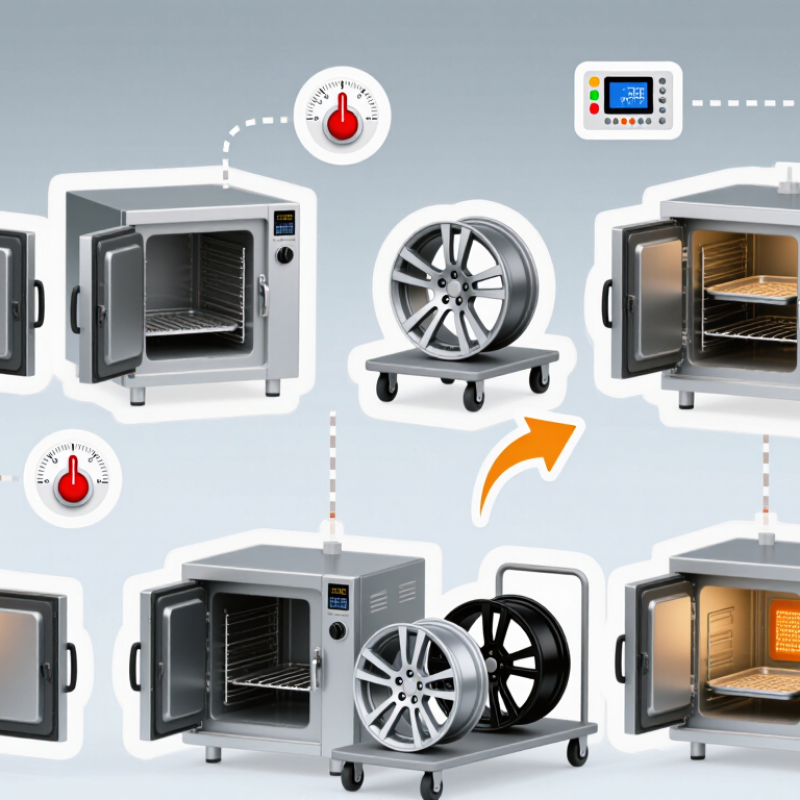
Choosing an alloy wheel curing oven starts with the largest wheel, not the average one. Measure the outside diameter, including any protruding features or protective fixtures. Then allow space between wheels and oven walls for loading and airflow. A 22-inch wheel may fit on paper but leave too little clearance when mounted on a rack. Check wheel width and loading orientation too. Small details matter.
Define batch load by both wheel count and total weight. Four heavy wheels can place a different strain on a rack than four lighter ones. Confirm the rack’s capacity and how evenly the wheels can be spaced. Overcrowding may limit heat circulation. It is easy to overestimate capacity. A trial with a representative load can reveal awkward handling, blocked airflow, or uneven temperature recovery. Record the actual loading pattern, not just the planned one.
Throughput means more than the oven’s stated cycle time. Include loading, heating, curing, cooling, and unloading when estimating daily output. Compare that full cycle with your expected order volume and available shifts. A shorter cycle may not help if operators cannot prepare the next batch quickly. Estimates can be optimistic, especially during busy production. Recheck them using real handling times and the coating supplier’s specified curing conditions.
Match Oven Capacity to Powder-Coat Cure Profiles: Typically 160–200°C
Choosing an alloy wheel curing oven starts with the coating’s technical data sheet, not the chamber’s maximum temperature. Many powder-coat profiles call for roughly 160–200°C, but cure time often starts only after the wheel reaches the specified metal temperature. The oven display can look reassuring. It may not show conditions at a thick hub or spoke.
Match oven capacity to both wheel size and daily workload. Leave room around each wheel so heated air can circulate, rather than packing the chamber tightly. Check how quickly the oven recovers after loading, and whether its controls hold a stable temperature across the working area. A single successful test deserves a second look. Wheel designs and coating thicknesses vary, so one result may not prove every load is cured evenly. Use suitable temperature probes on representative wheels, then compare readings with the coating supplier’s cure profile.
Tips: Confirm whether the stated cure temperature refers to air or part temperature. Record the wheel’s warm-up time and actual dwell time. Keep a little spare capacity; it helps with airflow, though it may raise energy use. That trade-off is easy to overlook.
Assess Temperature Uniformity, Energy Use, and NFPA 86 Safety
An alloy wheel curing oven should be judged by the temperature the wheel reaches, not only the controller’s setpoint. Uniformity is measurable. Map the chamber with calibrated thermocouples at several rack positions, then compare metal-temperature curves across a full load. A cool wheel center can leave coating undercured, while hot edges waste energy or damage the finish. Set an acceptable variation based on the coating supplier’s cure window; do not assume one tolerance suits every powder.
Energy use deserves the same practical scrutiny. The U.S. Department of Energy’s 2022 Industrial Decarbonization Roadmap estimates that process heating accounts for about 51% of manufacturing energy use. Ask suppliers for measured kWh per batch, warm-up time, and heat-loss data—not just burner ratings. Compare identical loads and cure cycles. NFPA 86 (2023) addresses oven and furnace safeguards, including purge, combustion controls, and interlocks. Verify these functions during commissioning and document test results. A polished interface is not proof of safe operation.
Tips: Request a loaded temperature-uniformity survey and review the raw readings. Check door seals, exhaust settings, and recovery time after loading. Small leaks add up. One caveat: reported savings can look impressive when baseline loads differ, so ask how each figure was measured.
Check Global Compatibility: Voltage, Emissions, Compliance, and Service Support
A curing oven that runs well in one factory may struggle after export. Confirm site voltage, frequency, phase, and available amperage before ordering. A 400 V, three-phase unit cannot simply be connected to a 230 V supply. Check control-circuit requirements and whether the supplier provides wiring diagrams for local electricians. Small mismatch, big delay.
Emissions and compliance need equal attention. Ask for fuel-use figures, exhaust details, and documentation for the intended coating process. Powder-coating operations may produce emissions that require local review; requirements vary by location. The International Energy Agency’s Energy Efficiency 2023 report estimates that industry accounts for about 37% of global final energy consumption, making oven efficiency a practical purchasing concern. Request measured heat-up time, temperature-uniformity data, and insulation specifications, not just a headline efficiency claim. Electrical documentation should also identify applicable standards, such as IEC 60204-1, while the buyer confirms local requirements.
Tips: Put your facility’s supply data, operating temperature, and service location in the request for quotation. Ask who handles commissioning, spare parts, and response times across borders. Get those details in writing. A small point can be missed: remote support may not include on-site repairs, and shipping a replacement sensor can still take days.
7 Best Alloy Wheel Curing Ovens for Global Buyers?
Check global compatibility: voltage, emissions, compliance, and service support.
Typical nominal three-phase voltages shown are indicative market references, not a guarantee of a specific site's supply. Confirm local voltage, frequency, phase, and oven nameplate requirements before purchase; emissions rules, required conformity documentation, and service coverage must also be checked for the destination market.