











JHY PCB Blog Hub
Your Source for Expert PCB Design, Manufacturing, and Assembly Insights – Stay Informed with 2025 Trends!
2026 Top TRV Radiator Suppliers for Global Buyers
In 2026, global heating buyers need more than attractive catalogs and low quotations. A reliable Trv Radiator supplier should demonstrate consistent production, accurate temperature control, and dependable after-sales support. Thermostatic radiator valves influence comfort, energy use, and system stability. Small faults can create large installation problems.
This guide examines leading suppliers through practical purchasing criteria. These include material quality, valve compatibility, factory capacity, testing procedures, certifications, and delivery performance. Buyers should check whether brass bodies resist corrosion and whether sensing heads respond smoothly to room temperature changes. Thread standards matter too. An M30 x 1.5 connection may not suit every heating system. Ask for drawings, samples, test reports, and clear warranty terms before placing large orders.
Details often reveal the real supplier quality. Inspect thread finishing, packaging protection, labeling, and carton strength. A damaged control head can delay an entire project. Request evidence of quality management and confirm certification validity for the destination market. Do not rely only on polished websites or impressive showroom photographs. Experience suggests that communication during sampling often predicts future cooperation. Yet no supplier evaluation is perfect. Lead times can shift, test documents may require clarification, and product performance can vary between batches. Buyers should leave room for verification.
The following supplier overview supports careful comparison. It is not a substitute for technical review or local compliance checks. Good decisions require evidence, patience, and honest questions. That is the practical starting point.
What TRV Radiators Are and How They Work
2026 Top TRV Radiator Suppliers for Global Buyers
What TRV Radiators Are and How They Work
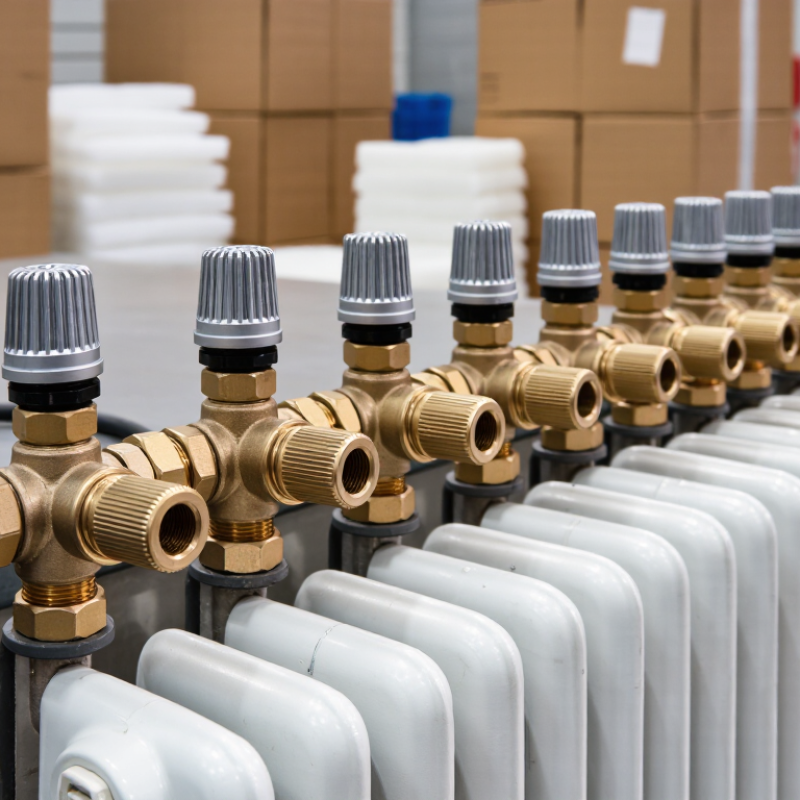
A thermostatic radiator valve, or TRV, controls water flow through a radiator. It does not heat the room directly. Instead, its sensor measures nearby air temperature and adjusts a small internal pin. When the room reaches the selected setting, the valve restricts hot-water flow. When the room cools, it opens again.
The mechanism is simple, but installation quality matters. A wax capsule, liquid sensor, or electronic probe moves the pin. Correct positioning helps the sensor read room air, not radiator heat. EN 215 provides performance requirements for thermostatic radiator valves. Buyers should request test evidence and declared temperature control ranges.
Energy performance makes TRVs relevant to global heating projects. The International Energy Agency reports that buildings use about 30% of global final energy. Eurostat reported that space heating represented roughly 63% of household energy use in the European Union in 2022. A TRV cannot solve poor insulation or an unbalanced system. That assumption needs challenging.
Tips: Keep curtains away from the valve. Do not cover it with furniture. Use lower settings in bedrooms and unused rooms. Check system balancing before judging valve performance. In field inspections, valves often appear faulty when air pockets or incorrect pump settings cause uneven heating. That detail is easy to miss.
Key Criteria for Evaluating Global TRV Radiator Suppliers
When evaluating TRV radiator suppliers, start with technical evidence, not polished catalog images. Ask for valve accuracy data, pressure-test records, material specifications, and temperature range results. A reliable supplier should explain how each test was performed. Factory experience matters too. Request installation examples from climates similar to your target market.
Check production consistency across samples. Order several units, then compare thread quality, handwheel movement, finish, and packaging protection. Small differences can signal larger process problems. Review quality-control checkpoints and batch traceability. Certificates should be current, verifiable, and relevant to the destination country. Generic paperwork is not enough.
Lead times deserve careful questioning. Ask about standard capacity, peak-season delays, spare parts, and replacement procedures. A clear warranty is useful, but response speed matters more when a project is already on site. Compare landed cost, not only unit price. Include freight, duties, testing, storage, and possible rework. Communication is another practical test: send detailed questions and measure the accuracy of the reply. No checklist is perfect. I have seen suppliers meet every document requirement but struggle with changing specifications. That risk should remain visible in your evaluation.
Leading TRV Radiator Suppliers in 2026
Leading TRV radiator suppliers in 2026 are competing on more than valve price. Global buyers now examine temperature accuracy, flow control, noise levels, and replacement compatibility. The International Energy Agency reports that buildings consume about 30% of global final energy. Space heating remains a major share of that demand. This gives thermostatic radiator valves a practical role in reducing unnecessary heat.
Reliable suppliers should provide valves tested against EN 215 requirements and maintain documented quality systems, such as ISO 9001 certification. Buyers should also request cycle-life results, leak testing records, and calibration details. Small details matter. A stiff actuator or poorly marked setting ring can create installation delays across hundreds of apartments. Suppliers with stable brass machining, clear packaging, and multilingual instructions usually reduce these risks. However, not every factory publishes complete test data. That gap deserves attention.
Eurostat reported that space heating represented roughly 63% of household energy use in the European Union in 2022. This figure supports stronger demand for responsive heating controls, especially in renovation projects. Leading TRV radiator suppliers increasingly offer mechanical and electronic models, with remote sensing and open-window detection in higher-end systems. Global buyers should compare warranty terms, minimum order quantities, spare-part availability, and support response times. A lower quotation may look attractive. It can become expensive when thread sizes, head connections, or shipping schedules do not match local standards. Supplier performance should be judged through samples, not promises alone.
Product Standards, Certifications, and Export Capabilities
2026 Top TRV Radiator Suppliers for Global Buyers
Reliable TRV radiator suppliers must prove more than production capacity. Their valves should meet recognized standards for temperature control, pressure resistance, thread accuracy, and leakage performance. EN 215 is commonly referenced for thermostatic radiator valves in European markets. However, buyers should confirm the latest applicable edition and test scope. A certificate alone is not enough.
Look for documented factory inspections, calibrated test equipment, and traceable batch records. ISO 9001 certification can support consistent quality management, but it does not guarantee every valve performs perfectly. Ask for material declarations, RoHS or REACH compliance where required, and market-specific conformity documents such as CE or UKCA. Small details matter. For example, an incorrect thread specification can cause installation delays and costly returns.
Export capability also requires practical evidence. Experienced suppliers should provide commercial invoices, packing lists, certificates of origin, and accurate HS classification support. Their packaging should protect delicate sensing elements during long sea transport. Clear manuals and multilingual labels reduce errors at the job site. Request recent inspection reports, sample approvals, and references from comparable projects. Some suppliers may present polished documents but weak after-sales processes. That gap deserves attention. A capable export team should explain lead times, spare parts, warranty limits, and complaint handling in writing. Even strong suppliers can miss a regional requirement, so independent verification remains a sensible step.
How Global Buyers Can Select the Right Supplier
2026 Top TRV Radiator Suppliers for Global Buyers
Selecting the right TRV radiator supplier requires more than comparing prices. In real projects, valve accuracy, heat output, and delivery consistency often matter more than a polished catalogue. Experienced buyers should request technical drawings, performance data, material specifications, and samples before placing a large order. A sample can reveal uneven coating, stiff valve movement, or weak thread quality within minutes.
Supplier reliability also depends on manufacturing evidence. Ask about production capacity, quality inspections, batch traceability, and testing procedures. Confirm that products meet the standards required in your destination market. Check packaging carefully, especially if radiators will travel by sea or face repeated warehouse handling. A damaged corner can delay installation and create unexpected costs. References from comparable commercial or residential projects are valuable, but they should be verified independently.
Tips: Compare the complete landed cost, not only the unit price. Review warranty terms, replacement procedures, spare valve availability, and response times. Request a written lead-time schedule. Then test one small shipment. It may feel slower, but assumptions often become expensive later. Do not ignore communication quality. Clear replies, accurate documents, and quick corrections usually indicate stronger operational control. Still, no supplier is perfect. Even a capable factory may miss a packaging detail or underestimate seasonal demand, so keep a practical contingency plan.
2026 Top TRV Radiator Suppliers for Global Buyers - How Global Buyers Can Select the Right Supplier
| Priority | Supplier Evaluation Dimension | Recommended Buyer Benchmark | Why It Matters for TRV Procurement | Documents or Evidence to Request | Suggested Weight | Buyer Assessment |
|---|---|---|---|---|---|---|
| 1 | Product conformity | Thermostatic radiator valves tested to the applicable EN 215 requirements for thermostatic radiator valves. | Independent performance verification helps confirm temperature-control behavior, repeatability, durability, and dimensional consistency. | Current test report, declaration of conformity where applicable, product specification, and test-laboratory details. | 20% | Mandatory |
| 2 | Temperature-control performance | Typical adjustable setpoint range around 5–28 °C, with frost-protection and shut-off functions available where required. | A suitable control range supports residential, commercial, and light-industrial heating applications while reducing overheating and energy waste. | Control-range data, hysteresis information, calibration method, frost-protection setting, and laboratory performance results. | 15% | High priority |
| 3 | Connection compatibility | Common configurations include DN15 valve bodies, 1/2-inch pipe connections, and M30 × 1.5 actuator interfaces; project requirements must be checked before ordering. | Connection mismatches can create installation delays, leakage risk, additional adapters, and higher lifecycle costs. | Dimensioned drawings, thread specifications, inlet and outlet configuration, adapter list, and compatibility chart. | 15% | Mandatory |
| 4 | Pressure and temperature rating | Verify the working-pressure and media-temperature limits against the heating system design. Do not accept a generic rating without a technical data sheet. | Valve life and safety depend on compatibility with system pressure, water temperature, heating medium, and operating conditions. | Pressure-temperature chart, maximum differential-pressure data, material declaration, and installation instructions. | 12% | Mandatory |
| 5 | Material and corrosion resistance | Prefer clearly identified valve-body materials, corrosion-resistant internal parts, durable seals, and materials suitable for closed-loop hydronic systems. | Material quality affects leakage resistance, service life, water compatibility, and performance in areas with demanding water conditions. | Bill of materials, material certificates, seal-material information, corrosion test data, and restricted-substance declarations. | 10% | High priority |
| 6 | Quality-management system | A documented quality system, preferably supported by a current ISO 9001 certificate issued for the relevant manufacturing site. | Process control, incoming inspection, traceability, and corrective-action procedures reduce batch-to-batch variation. | Certificate scope, certificate validity, factory address, inspection plan, and sample quality records. | 10% | High priority |
| 7 | Production and inspection capacity | Supplier should provide documented production capacity, final inspection procedures, leakage testing, and batch traceability. | Capacity transparency helps global buyers avoid shipment delays and ensures that high-volume orders receive consistent inspection. | Monthly capacity statement, production-flow description, in-process inspection plan, final-test records, and lot-code format. | 8% | High priority |
| 8 | Customization capability | Assess capability for private-label packaging, custom handwheel markings, connection variants, presetting, color requirements, and packaging language. | Customization can support local regulations, distributor requirements, project specifications, and installation preferences. | Customization catalogue, engineering-change procedure, sample approval process, tooling charges, and minimum order quantity. | 6% | Project dependent |
| 9 | Lead time and supply continuity | Require a written production lead-time range, realistic safety-stock policy, forecast process, and escalation contact for export orders. | Radiator-valve projects are often tied to construction schedules, seasonal heating demand, and installation windows. | Standard lead time, sample lead time, capacity calendar, continuity plan, and agreed on-time-delivery terms. | 7% | High priority |
| 10 | Export and packaging readiness | Packaging should protect threads, stems, seals, and adjustment heads during international transport; carton and pallet markings should be export-ready. | Correct packaging reduces transit damage, installation defects, customs delays, and warehouse handling problems. | Packaging specification, drop-test method where applicable, carton dimensions, pallet plan, HS-code proposal, and shipping documents. | 4% | Important |
| 11 | Warranty and technical support | Look for clearly defined warranty duration, replacement procedure, installation guidance, troubleshooting support, and response-time commitments. | Effective after-sales support limits project disruption and helps distributors resolve compatibility or installation issues quickly. | Warranty policy, service-level commitment, spare-parts list, technical manuals, and claim-handling workflow. | 3% | Important |


